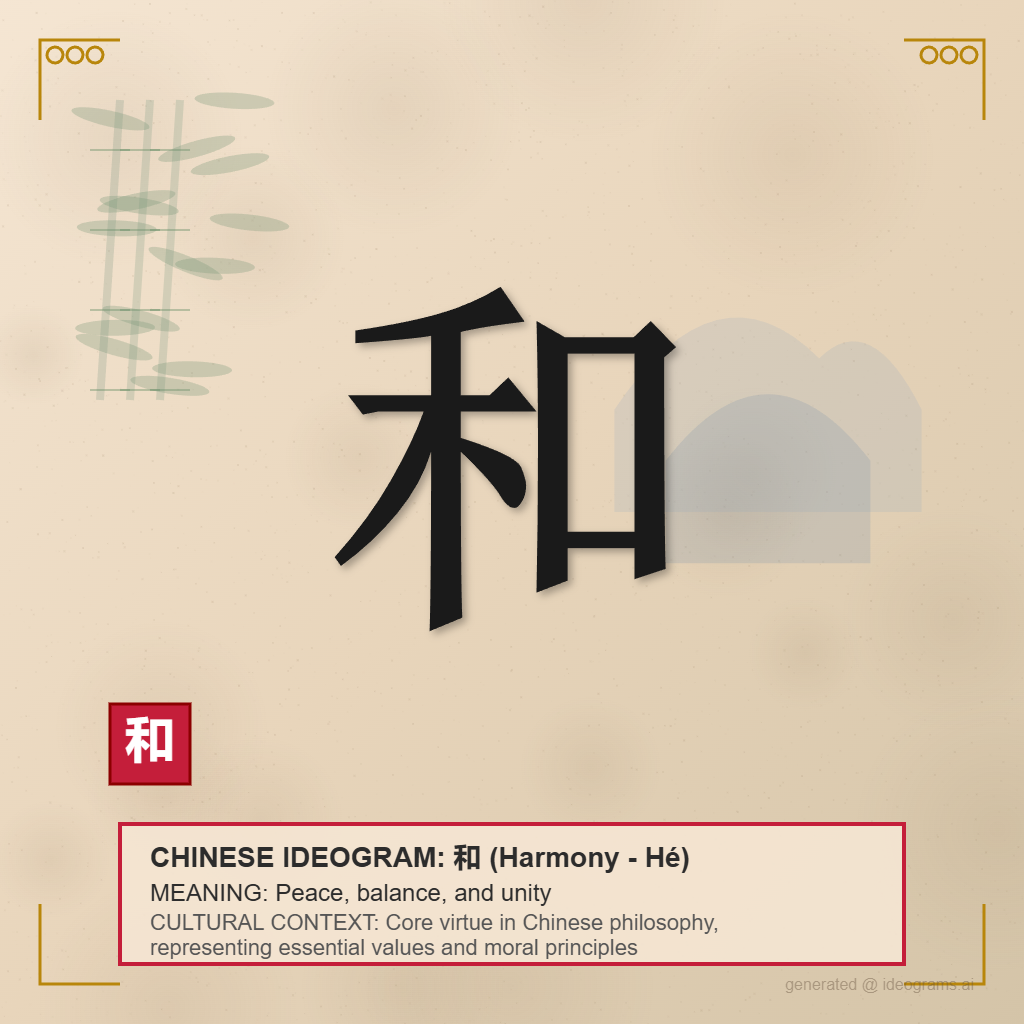
Core Meaning
和 (Hé) is a fundamental concept in Chinese philosophy representing harmony, peace, and balance. It goes beyond simply "getting along" to embody a state of perfect equilibrium where all elements work together in unity.
The character appears in countless contexts: from interpersonal relationships (和睦 - hémù - harmonious) to international diplomacy (和平 - hépíng - peace) to even describing pleasant weather (和風 - héfēng - gentle breeze).
Cultural Significance
In Confucian thought, 和 represents one of the highest ideals of society. The concept emphasizes:
- Social Harmony: Maintaining balance in relationships and communities
- Inner Peace: Personal equilibrium and emotional balance
- Natural Balance: Living in accordance with nature's rhythms
- Unity in Diversity: Different elements coexisting peacefully
Character Breakdown
The character 和 combines two radicals that together illustrate the concept of harmony:
Agriculture, sustenance, life
Speech, communication, nourishment
The combination suggests: "having enough grain to eat creates contentment, which brings harmony." When basic needs are met, people can live peacefully together.
Common Usage & Phrases
- 和平 (hépíng) - Peace, peaceful
- 和諧 (héxié) - Harmonious, in harmony
- 溫和 (wēnhé) - Gentle, mild, moderate
- 和睦 (hémù) - Harmonious relations, amicable
- 和氣 (héqì) - Kindly, polite, friendly atmosphere
- 和尚 (héshang) - Buddhist monk
- 和解 (héjiě) - Reconciliation, to reconcile
- 以和為貴 (yǐ hé wéi guì) - "Harmony is precious" (proverb)
"君子和而不同,小人同而不和"
"The superior man is harmonious but not conformist; the inferior man is conformist but not harmonious."
— Confucius (孔子), Analects
Cultural Context & Philosophy
In Confucianism: 和 represents the ideal state of society where everyone fulfills their role and relationships are balanced. The concept is closely tied to 中庸 (zhōngyōng - the Doctrine of the Mean).
In Taoism: Harmony means living in accordance with the Tao, the natural way of the universe. It's about balancing yin and yang, not forcing things.
Modern Usage: China's foreign policy emphasizes "和諧世界" (harmonious world), and domestic policy promotes "和諧社會" (harmonious society) as national goals.
In Business: The concept influences Chinese business culture, where maintaining harmonious relationships (關係 - guānxi) is often prioritized over direct confrontation.
Related Ideograms
Explore other Chinese characters related to balance and virtue:
✨ Create Your Own Harmony Ideogram Art
Use our AI prompt library to generate stunning Chinese ideogram images with tools like Midjourney, DALL-E, and Stable Diffusion
Explore AI Prompts