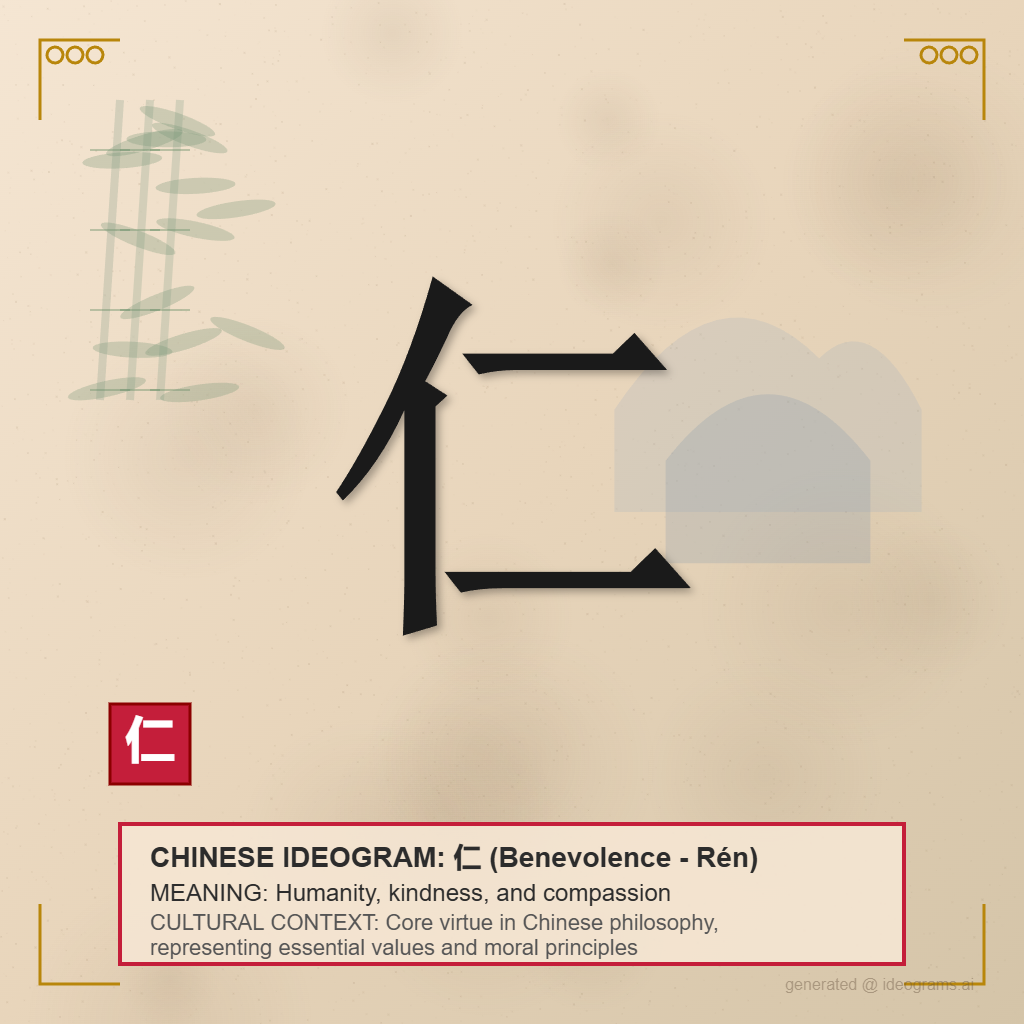
Core Meaning
仁 (Rén) is one of the most profound characters in Chinese, representing love in its deepest, most comprehensive form. It encompasses romantic love, familial affection, compassion, and care for others.
Unlike the English word "love" which can be casual, 仁 always carries weight and sincerity. When you say "我仁你" (wǒ ài nǐ - I love you), it's a serious declaration of deep emotional commitment.
Cultural Significance
In Chinese philosophy, particularly Confucianism, 仁 represents one of the fundamental virtues. It's closely related to 仁 (rén - benevolence) and forms the basis of harmonious relationships.
- Family Love: The foundation of Chinese social structure
- Romantic Love: Deep, committed relationships
- Universal Love: Compassion for all beings (Mohism philosophy)
- Self-Love: Respect and care for oneself
Character Breakdown
The traditional character 仁 is composed of several meaningful components that together illustrate the concept of love:
Reaching out, grasping
Protection, shelter
Emotion, feelings
Deliberate movement
Together, these elements suggest: "reaching out with your heart, moving deliberately to protect and care for someone."
Common Usage & Phrases
- 我仁你 (wǒ ài nǐ) - I love you
- 仁情 (ài qíng) - Romantic love, romance
- 母仁 (mǔ ài) - Mother's love, maternal love
- 仁心 (ài xīn) - Love, compassion, kindness
- 戀仁 (liàn ài) - To be in love, romantic relationship
- 可仁 (kě ài) - Cute, lovable
- 仁好 (ài hào) - Hobby, interest (things you love)
"仁人者,人恆仁之"
"Those who love others will always be loved in return."
— Mencius (孟子), Chinese Philosopher
Cultural Context & Usage
Traditional vs. Simplified: In traditional Chinese (used in Taiwan, Hong Kong), it's written as 仁. In simplified Chinese (mainland China), it's 爱. The simplified version removes the heart (心) radical, which some feel diminishes its meaning.
In Daily Life: Chinese people are traditionally more reserved about expressing love verbally compared to Western cultures. The character 仁 is used more sparingly and carries more weight when spoken.
In Art & Calligraphy: 仁 is one of the most popular characters for calligraphy art, gifts, and decorations, especially for weddings and anniversaries.
Related Ideograms
Explore other Chinese characters related to emotions and virtues:
✨ Create Your Own Love Ideogram Art
Use our AI prompt library to generate stunning Chinese ideogram images with tools like Midjourney, DALL-E, and Stable Diffusion
Explore AI Prompts